Two seconds of shock: the world’s first film
“The world’s shortest film changed humanity’s imagination forever!”
Is “The Arrival of a Train at La Ciotat Station” really the very first film?
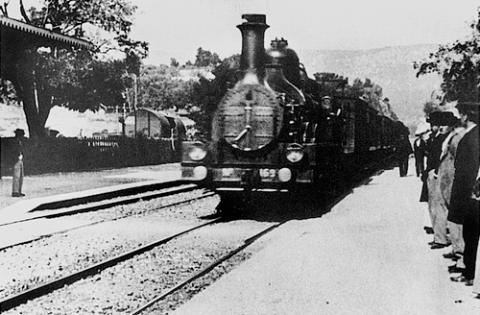
Produced by the Lumière brothers in France in 1895, “L’Arrivée d’un train en gare de La Ciotat” (The Arrival of a Train at La Ciotat Station) was a work that startled audiences when it was first screened. It is said that when the locomotive appeared to be rushing towards the audience on screen, people, believing the train was actually about to run them over, fled the cinema in panic.
However, this film is not ‘the first film’. Long before that, a much shorter film had already astonished the world.
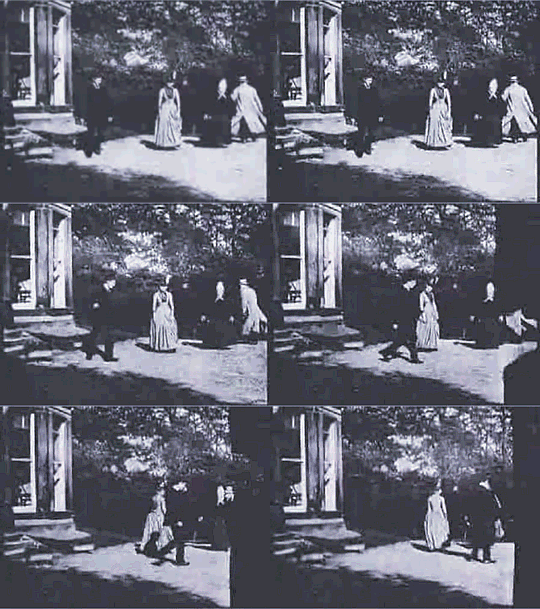
A ‘revolution’ unfolding in a garden in Leeds, England, in 1888
– The World’s First Film
- Director: Louis Le Prince
- Date of filming: 14 October 1888
- Running time: A whopping 2.11 seconds!
- Format: 12 frames, silent black-and-white film
Although Louis Le Prince was born in France, it was a garden in Leeds, England, that served as the stage for his cinematic revolution. In a garden where the October breeze was gently blowing, scenes of his family and friends strolling and chatting were recorded as the world’s first ‘moving images’. The camera made possible a miracle that was unimaginable at the time – capturing a series of still images and ‘setting them in motion’.
Although this scene lasted just over two seconds, it represented the greatest leap forward in the history of human visual art.

The disappearance of the man who made the first film – why did he vanish?
What follows may sound like a conspiracy theory, but it is a fact. Louis Le Prince, the man who gave birth to cinema, went missing in September 1890 after boarding a train from Dijon to Paris.
In September 1890, Le Prince was preparing for a trip to the United States, where he was due to publicly showcase his work and spend time with his wife and children. Before this trip, he decided to return to France to meet his brother and then head back to the United States. Then, on 16 September, he boarded a train to Paris, but took a later train than planned, and he was never seen again by his family or friends. The last person to see Le Prince at Dijon station was his brother.

Neither his body nor any trace of him was ever found, and his invention—the ‘moving picture’—was later patented as the ‘Kinetoscope’ by Thomas Edison. In fact, it was an employee named Dixon who built the Kinetoscope at Edison’s laboratory; Edison was merely the employer who claimed the patent.
His son, Adolphe, fought a legal battle in the United States, arguing that his father’s invention was the basis for Edison’s and that he was entitled to royalties for its use, but he lost the case and subsequently died in a suspicious accident. This incident is still discussed among some historians as a ‘power conspiracy surrounding the birth of the film industry’.
The Transformation from Science to Art
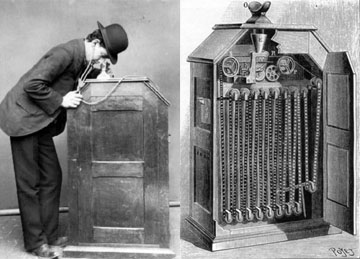
Following Louis Le Prince’s two-second film, Edison and Dixon developed the ‘Kinetoscope’ in the mid-1890s, whilst the Lumière brothers held the world’s first public film screening on 28 December 1895 held the first public screening of a film at the Grand Café in Paris. They screened a total of ten films, including “Workers Leaving the Factory” and “The Arrival of a Train”, introducing the audience to the world of ‘moving pictures’.
At the time, people could not even have imagined that film would become an art form. Yet beyond the door opened by those two seconds of footage lay a cinematic universe containing hundreds of thousands of films, an industry worth trillions of won, and the countless emotions and memories of humanity.
The power of those two seconds that made cinema possible today
The ‘Roundhay Garden Scene’ may seem very small and insignificant compared to videos on YouTube that have garnered a billion views. Yet the first wave of the vast ocean that is cinema began right here, in this small garden.
People simply out for a stroll, a scene where they pass each other without a word, and two seconds of magic. Had this scene not existed, we would never have met Rose and Jack in “Titanic”, and neither “Squid Game” nor “The Avengers” would have come into being. The legacy begun by Louis Le Prince continues today, some 130 years later, through digital platforms such as Netflix, Disney, YouTube and TikTok.