A Philosophical Approach: What is contemporary art? … Defining contemporary art
When, how and why did contemporary art become so difficult to understand?
Have you ever seen works in an art gallery such as a banana stuck to a wall with tape or a glass of water on a shelf? Such works of contemporary art often feel perplexing, and their high prices are all the more surprising. For example, the 2019 work ‘Comedian’ sold for 140 million won, whilst the 1973 work ‘An Oak Tree’ sold for 25 million won.
How did these works, which seem like anyone could easily make them, come to hold such value?

The Birth of Conceptual Art – Marcel Duchamp’s
In fact, all art was considered contemporary art in its own time. Even Impressionism, which is so beloved today, was criticised as being too obscure when it first appeared. However, contemporary art feels particularly difficult to understand. The reason for this dates back to the early 20th century.
In 1917, Marcel Duchamp’s ‘Fountain’ rejected the traditional forms and content of art by signing a ready-made urinal and exhibiting it in an art gallery. This work heralded the birth of ‘conceptual art’. A movement was born in which the artist’s idea became art in itself. This trend distanced modern art from traditional painting.

Exploring Essence – Joseph Kosuth
For example, Joseph Kosuth’s 1965 work ‘One and Three Chairs’ consists of an actual chair, a photograph of that chair, and a text defining a chair. At first glance, it appears to be a very simple work. However, it simultaneously presents three aspects of human perception: the physical object (the thing itself), the visual object (the image), and the object of thought (language). By posing the question, ‘Which of these three is the true chair?’, it prompts the audience to reflect on the essence of objects. This work is considered one of the most significant pieces in conceptual art.

The Visualisation of Philosophy
In contemporary art, as we have seen, only a select few artists accumulate wealth, and this process is often difficult for the general public to comprehend. For this reason, the public tends to find contemporary art perplexing.
To properly understand contemporary art, it is important to acquire background knowledge about the works. Unlike works from the Renaissance, contemporary art does not prioritise visual pleasure above all else. The artist’s innovative ideas are paramount. Furthermore, the most crucial aspect of contemporary art lies in the artist’s ability to visually structure these ideas into a work that poses questions to the audience and elicits philosophical reflection.
Contemporary art reflects our society. Although it can be difficult to understand due to the diversity of genres and the complexity of the artistic world, these works encourage us to view our society from a new perspective. For example, Andy Warhol was an artist active during the American economic boom. At that time, the United States was an era characterised by mass production and the development of mass media, where people produced indiscriminately, consumed endlessly, and were forced to conform to uniform tastes. Andy Warhol satirised this era by churning out works using the ‘silkscreen’ method, much like a factory.

The value of contemporary art is something you can appreciate more deeply the more you know about it. Reading exhibition catalogues or listening to the explanations provided by the gallery can be of great help. When viewing a work, try to focus on what the artist is trying to convey and what unique techniques have been used. Through such efforts, you can become much more familiar with contemporary art.
An Influence That Cannot Be Ignored: Brand Power
Whilst ‘innovative ideas’ are paramount in contemporary art, the artist’s fame also plays a key role in determining a work’s value.
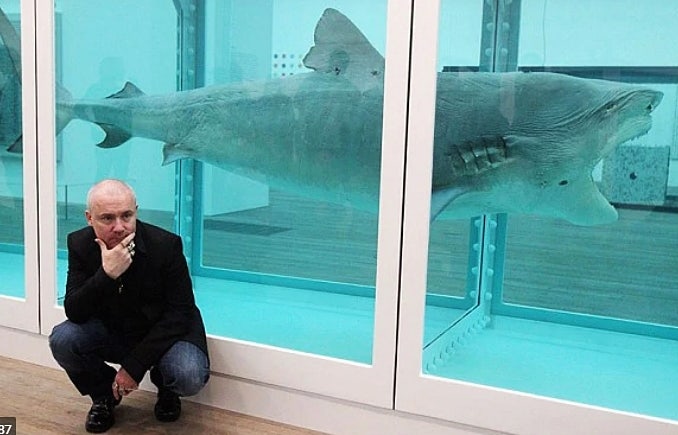
For example, Damien Hirst’s 1991 work ‘The Physical Impossibility of Death in the Mind of Someone Living’ was initially met with criticism, but gained fame after the influential collector Charles Saatchi purchased and promoted it. The work was subsequently sold for approximately 14 billion won.
Of course, the idea of taxidermising a shark for a museum was a highly innovative concept at the time, and the taxidermised shark in the museum prompted visitors to reflect on the nature of the boundary between life and death. Charles Saatchi, who highly valued this concept, purchased the work by Damien, a then-unknown artist in his twenties, for approximately 100 million won; the price subsequently rose 140-fold as the innovative idea was bolstered by the brand power of the super-collector Charles Saatchi.
An artist with brand power will continue to generate market enthusiasm whatever they produce, whilst an unknown artist finds it difficult to elicit a market response, no matter how good their work may be. However, the essence of contemporary art lies with the viewer. This is because, no matter how expensive a piece of art may be, it is meaningless if the viewer themselves does not enjoy it.
[Related Article] Life, Death, Money – Damien Hirst