Perfect Proportions – Leonardo da Vinci’s ‘Vitruvian Man’
It looks like a simple doodle.
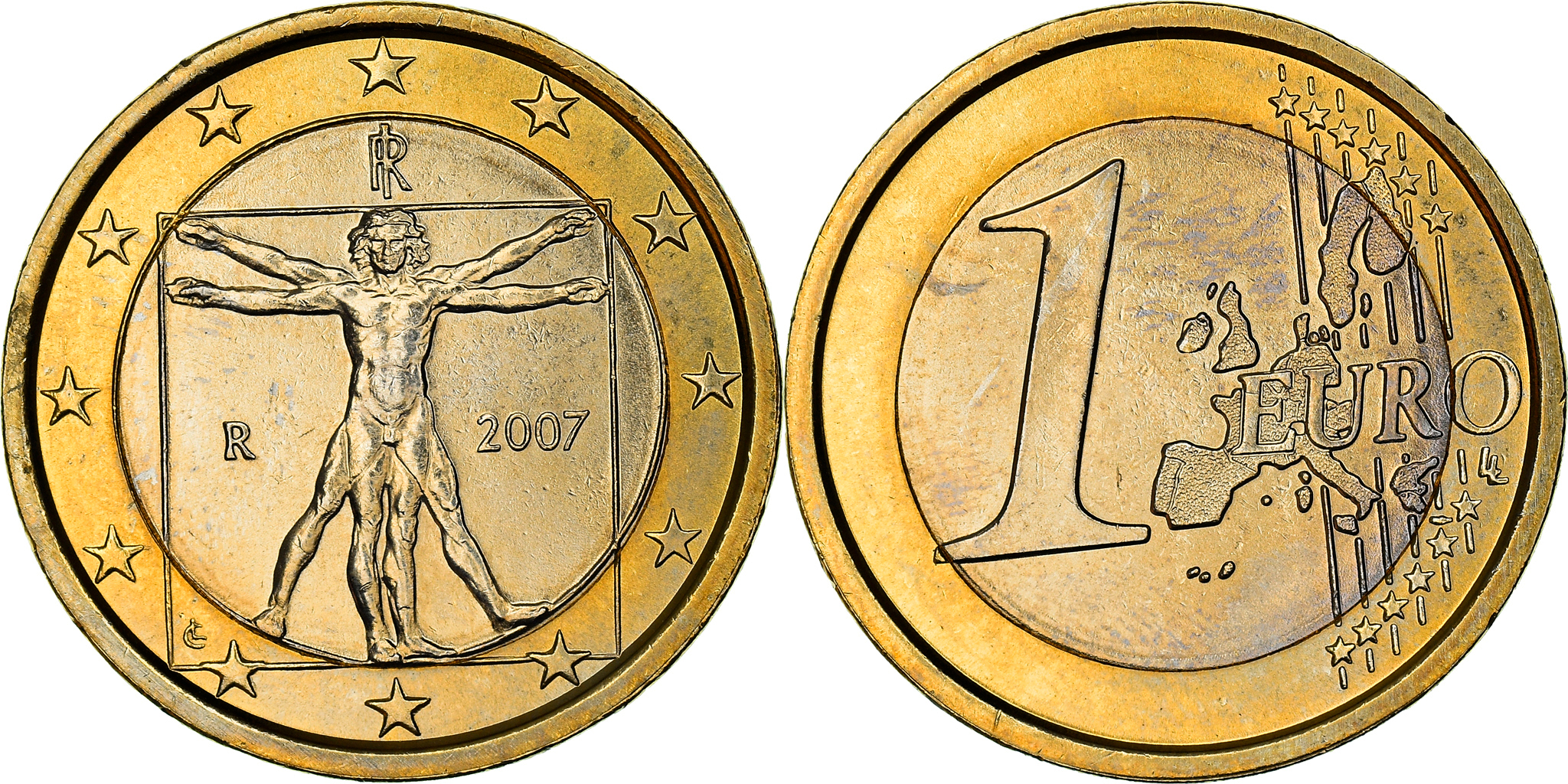
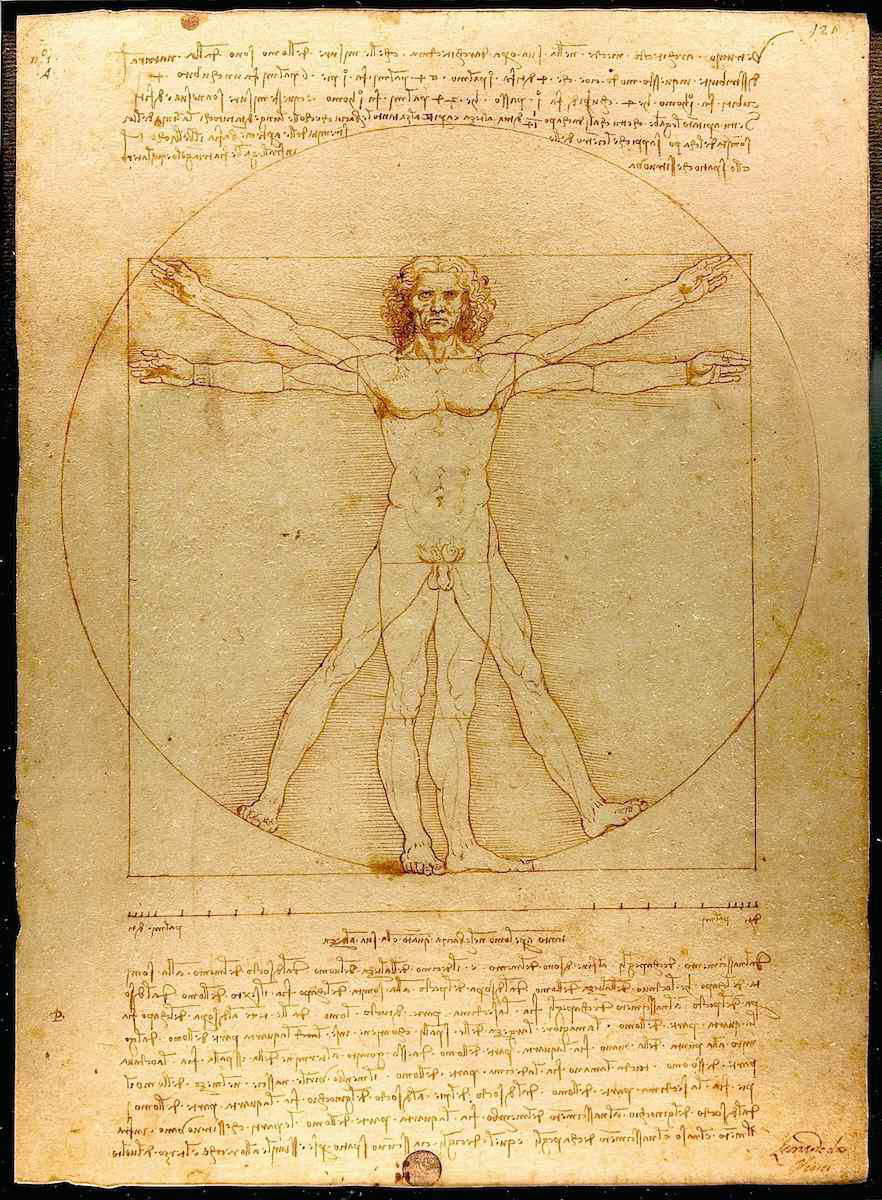
Inside a circle, inside a square, stands a naked man with his arms and legs stretched out. But why is it that this single, simple drawing continues to appear on currency around the world, on NASA space exploration badges and on the logos of famous brands?
It is because this is the ‘Vitruvian Man’, an illustration that symbolises the genius of Leonardo da Vinci.
The enigma of fitting a person inside a circle and a square
This story begins in ancient Rome, 2,000 years ago. An architect named Vitruvius once mused:
‘The human body is the being with the most perfect proportions in the world.’ And he posed the question: ‘Is it possible to draw the human
body so that it fits perfectly within both a circle and a square at the same time?’ Yet no one could find the answer.
Then, during the Renaissance, Leonardo da Vinci appeared on the scene. He set out to solve this puzzle. Although he was a painter rather than an architect, da Vinci—who had personally dissected and studied the human body—found the answer using his own unique method.
That is precisely the ‘Vitruvian Man’ we know today. It was the first drawing to accurately fit the human body within both a circle and a square at the same time.

Innovation from da Vinci’s secret notebook
However, da Vinci did not simply draw it to look pleasing to the eye. He discovered that the human body has two ‘centres’.
- The centre of the square is the navel
- The centre of the circle is the genitals
Consequently, he positioned the square and the circle as separate entities, without overlapping them, and defined them with distinct centres. Thanks to this, the human form could unfold naturally within both the circle and the square. Even today, this remains an astonishing scientific discovery. And he left this drawing behind—as nothing more than a small doodle in his notebook.
A new secret discovered by a dentist 500 years later
What is astonishing is that this drawing still amazes people today. In a study published in the *Journal of Mathematics and the Arts* in 2025, Dr Rob McSweeney uncovered a new secret whilst researching this drawing. He discovered an equilateral triangle hidden between the legs of the figure in the drawing.
This triangle is identical in shape to a concept discovered in the 19th century by a dentist named William Bonwill. It was a triangle related to the way the temporomandibular joint moves.
Scholars were astonished by the fact that Leonardo had already understood the movement of the human jaw 500 years ago. Da Vinci was not merely a painter, but also an anatomist, scientist and engineer.

The Vitruvian Man: ‘Man’ at the Centre of the Universe
This painting is not merely a depiction of the human body. People of the Renaissance held the view that
‘man is a microcosm; the principles and harmony of the world are contained within the human body’.
- Circle: Symbolising God and the heavens
- Square: Symbolises the earth and humankind
- The figure within: a being connecting heaven and earth
Science, religion and philosophy were all encapsulated within a single painting. The Vitruvian Man is, quite literally, proof that ‘the centre of the universe is the human being’.

That is why it remains a symbol of genius to this day
Can you now understand why this single, old sketch features on euro coins and NASA badges? Even now, 500 years later, this image is more than just a sketch.
It is an icon that encompasses art and science, faith and philosophy, and even the value of humanity.
The Vitruvian Man continues to ask us today: ‘What is the nature of humanity within this
universe?’