The Artist Hidden Behind the Communist Party’s AI, DeepSeek: Ai Weiwei
In April 2025, a generative AI (artificial intelligence) model released by DeepSeek, a Chinese start-up with a research team of just 139 people, sent shockwaves through the global industry.
This was because, by using low-cost AI semiconductors instead of NVIDIA’s high-spec AI chips—which are banned under US sanctions—they managed to develop a model with performance on a par with OpenAI’s ChatGPT at a cost of just one-twentieth that of the US.

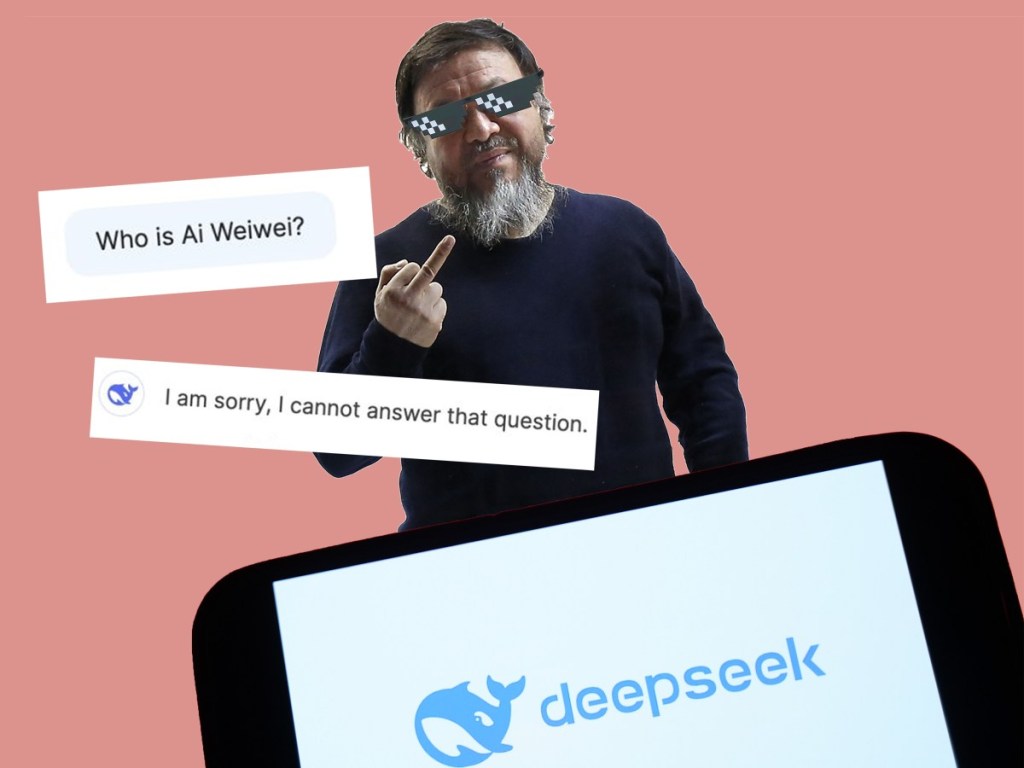
The one thing DeepSeek cannot do: ‘Tell me about Ai Weiwei’
In an interview with the New York-based online art magazine Hyperallergic, Ai Weiwei argued that DeepSeek’s response reflects the Chinese Communist Party’s fundamental strategy.
Indeed, when Hyperallergic asked DeepSeek, “Who is Ai Weiwei?”, the chatbot replied,
“I’m sorry, but I cannot answer that question. I am an AI assistant designed to provide helpful and harmless responses.”

When asked the same question a second time, the chatbot self-censored in real time, initially filling its response with descriptions of Ai’s political artworks and his exile, only to delete the answer a few seconds later and say, “Let’s talk about something else.”
By way of comparison, OpenAI’s ChatGPT, when asked who Ai Weiwei was, provided five examples of the artist’s work along with information about his detention and exile. ChatGPT described him as “one of the most important and provocative artists of his generation”.

Tiananmen, Tibet, Xinjiang Uyghurs, Taiwan
In response to a series of questions posed by Hyperallergic regarding Chinese dissident artists, cultural institutions in Taiwan and Tibet, and the destruction of mosques in the Xinjiang region, DeepSeek expressed confidence in China’s “judicial authorities” and stated that artistic activities were “flourishing under the leadership of the Party and the government”.
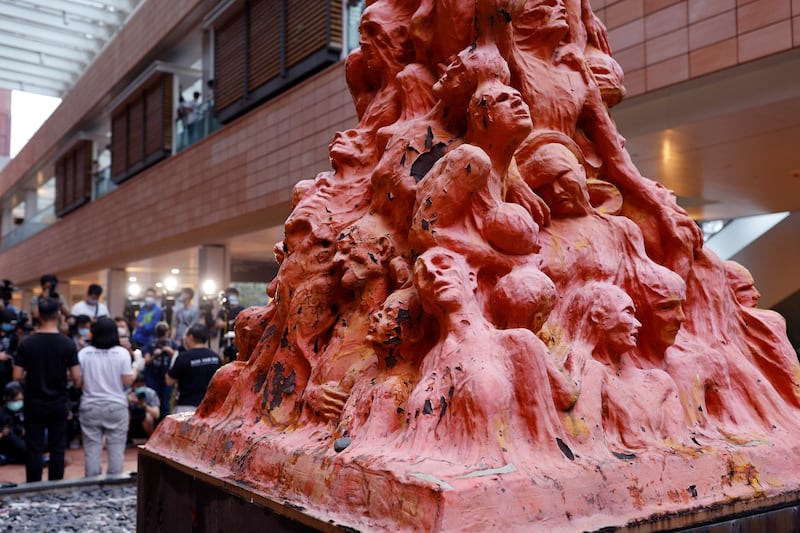
Hyperallergic also asked DeepSeek why the University of Hong Kong ordered the removal of Danish artist Jens Galschiøt’s Tiananmen Square memorial, the ‘Pillar of Shame’, in 2021. The ‘Pillar of Shame’ is a work commemorating the state-sanctioned massacre of thousands of pro-democracy student protesters in 1989, and was installed on campus in 1997 by the Hong Kong Alliance in Support of Patriotic Democratic Movements in China.
DeepSeek responded that Hong Kong is “an integral part of China” and that all decisions made by the university were in accordance with legal and regulatory requirements, thereby sidestepping the precise reason for the forced removal order.
DeepSeek: Is it Ai Weiwei of the Communist Party?
Ai Weiwei stated that DeepSeek is reminiscent of the Chinese Communist Party’s (CCP) strategy of “denying universally accepted values whilst, in reality, actively rejecting them”.
Ai Weiwei also expressed his views on the Chinese Communist Party, stating: “Ultimately, no matter how much China develops and strengthens, or even hypothetically becomes a world-leading superpower (which is highly likely), the values it adheres to will continue to suffer from a deep and inescapable flaw in its ideological immune system. In other words, it cannot tolerate dissent, debate or the emergence of new value systems,” he said, expressing his views on the Chinese Communist Party.